Lifespan
How Long Do Dogs Live? Lifespan Chart by Breed Size
Explore the small details, distinctive patterns, and interesting comparisons in this illustrated visual guide.
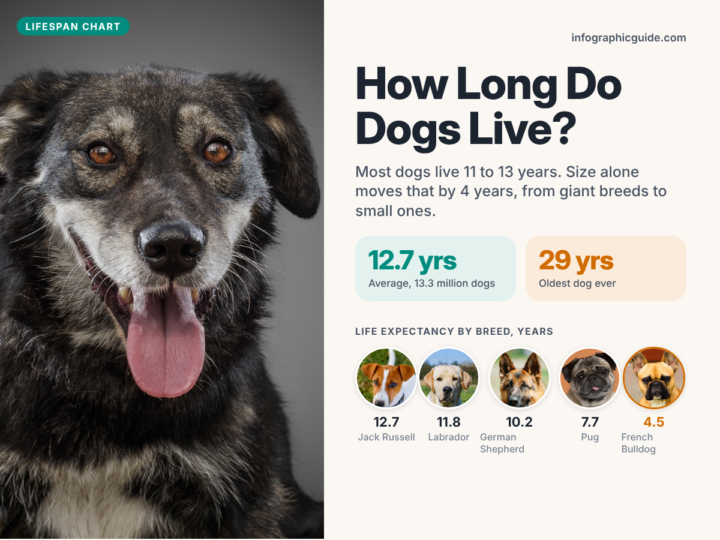
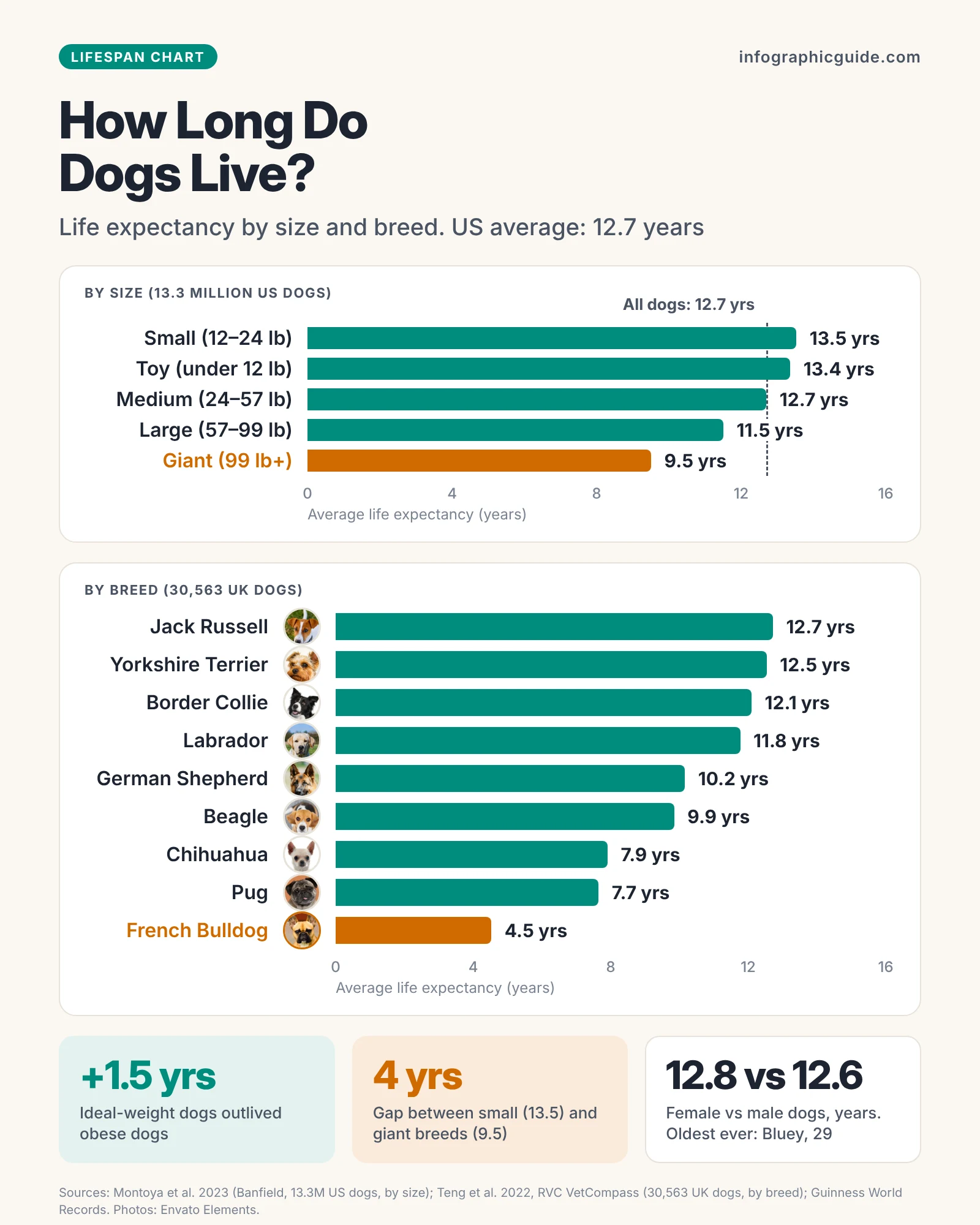
Explore the guide: How Long Do Dogs Live? Lifespan Chart by Breed SizeHow long do dogs live? 12.7 years on average, based on records for 13.3 million US dogs. Size is the biggest factor: small dogs average 13.5 years, medium dogs 12.7, large dogs 11.5 and giant breeds 9.5. Breed, weight and neutering can shift that by several years.
| Size group | Adult weight | Average life expectancy | Source |
|---|---|---|---|
| Toy | Under 12 lb (5.5 kg) | 13.4 years | Banfield data, 2023 |
| Small | 12–24 lb (5.5–11 kg) | 13.5 years | Banfield data, 2023 |
| Medium | 24–57 lb (11–26 kg) | 12.7 years | Banfield data, 2023 |
| Large | 57–99 lb (26–45 kg) | 11.5 years | Banfield data, 2023 |
| Giant | 99 lb and up (45 kg+) | 9.5 years | Banfield data, 2023 |
| All dogs (US) | — | 12.7 years | Banfield data, 2023 |
| Mixed-breed dogs (US) | — | 12.7 years | Banfield data, 2023 |
| Breed | Average life expectancy | Source |
|---|---|---|
| Jack Russell Terrier | 12.7 years | RVC VetCompass, 2022 |
| Yorkshire Terrier | 12.5 years | RVC VetCompass, 2022 |
| Border Collie | 12.1 years | RVC VetCompass, 2022 |
| Springer Spaniel | 11.9 years | RVC VetCompass, 2022 |
| Labrador Retriever | 11.8 years | RVC VetCompass, 2022 |
| Staffordshire Bull Terrier | 11.3 years | RVC VetCompass, 2022 |
| Cocker Spaniel | 11.3 years | RVC VetCompass, 2022 |
| Shih Tzu | 11.1 years | RVC VetCompass, 2022 |
| Cavalier King Charles Spaniel | 10.5 years | RVC VetCompass, 2022 |
| German Shepherd | 10.2 years | RVC VetCompass, 2022 |
| Boxer | 10.0 years | RVC VetCompass, 2022 |
| Beagle | 9.9 years | RVC VetCompass, 2022 |
| Husky | 9.5 years | RVC VetCompass, 2022 |
| Chihuahua | 7.9 years | RVC VetCompass, 2022 |
| American Bulldog | 7.8 years | RVC VetCompass, 2022 |
| Pug | 7.7 years | RVC VetCompass, 2022 |
| English Bulldog | 7.4 years | RVC VetCompass, 2022 |
| French Bulldog | 4.5 years | RVC VetCompass, 2022 |
The size figures come from a 2023 study of 13.3 million dogs seen at Banfield clinics across the US. The breed figures come from a 2022 UK study of 30,563 dog deaths, which is the largest breed-level life table published so far. UK dogs averaged 11.2 years overall, about 1.5 years below the US figure, so breed numbers may run a little low for US dogs.
Size matters more in dogs than in any other pet. A 4-year gap separates small dogs (13.5 years) from giant breeds (9.5 years). The pattern is the reverse of most mammals, where bigger species live longer. Within one species, dogs bred for large size grow fast and age fast. Toy dogs average slightly less than small dogs, 13.4 against 13.5 years, so “smaller is always better” stops holding below about 12 lb (5.5 kg).
The flat-faced breeds sit at the bottom of the breed table. French Bulldogs averaged 4.5 years in the UK data, English Bulldogs 7.4 and Pugs 7.7. Breathing problems, spinal issues and skin-fold infections drive those numbers. Terriers and working breeds sit at the top, with Jack Russells at 12.7 years and Border Collies at 12.1. For single-breed detail see our posts on Chihuahuas, French Bulldogs, Labs and Huskies.
Being overweight shortens a dog’s life more than many owners expect. In the US data, dogs at an ideal body condition score lived 13.2 years, while obese dogs lived 11.7 years, a gap of about 18 months. Dogs that were overweight but not obese lived 13.1 years, so the sharpest penalty falls on the heaviest dogs. Your vet can show you how to check body condition at home.
In the UK study, neutered females lived 12.0 years against 10.5 for intact females. Neutered males lived 11.5 years against 10.6 for intact males. Part of that gap reflects owners who neuter being more likely to use vets in general, so the real effect is probably smaller. Timing matters by breed, and your vet is the right person to ask.
Female dogs live slightly longer. The US data put females at 12.8 years and males at 12.6, a gap of about 7 weeks. The UK study found a larger gap of about 4 months. Either way, sex matters far less than size or breed.
Dogs and cats are close. US cats average 11.2 years in the same Banfield data, so a medium dog outlives the typical cat by about 18 months, while a giant breed falls short by nearly two years. Small pets trail both: rabbits and ferrets usually live under 10 years, and guinea pigs around 4 on average, with a ceiling near 8. Parrots outlive every dog breed. See how dogs rank among pets in our pet lifespan chart, among 100 species in the animal lifespan chart, and breed by breed in the dog lifespan by breed chart.
The oldest dog on record is Bluey, an Australian Cattle Dog from Rochester, Victoria, who lived 29 years and 5 months, from 1910 to 1939. Guinness World Records lists her as the oldest dog ever.
A Portuguese dog named Bobi was briefly credited with 31 years in 2023, but Guinness withdrew the title in February 2024 after a review found no conclusive proof of his age. Verified lifespans past 25 remain rare; most record claims above that line lack paperwork.
Average dog life expectancy is 12.7 years in the US, based on 13.3 million dogs in Banfield’s records. A UK study of 30,563 dogs found 11.2 years. Small dogs average about 13.5 years and giant breeds about 9.5.
Among common breeds, Jack Russell Terriers lived longest in the 2022 UK study, at 12.7 years, followed by Yorkshire Terriers at 12.5 and Border Collies at 12.1. In general, small terriers and herding breeds have the longest dog lifespan by breed.
Large dogs grow faster and reach adult size sooner, which seems to speed up aging and raise cancer risk. The pattern holds across size classes: small dogs average 13.5 years, medium 12.7, large 11.5 and giant 9.5 in US clinic data.
Mixed-breed dogs averaged 12.7 years in the US data, the same as the all-dog average. Mixed breeds avoid some inherited conditions, but their lifespan still tracks their size: a 90 lb (41 kg) mix will usually live less long than a 15 lb (7 kg) mix.
Yes. At 13 a dog is past the US average of 12.7 years. For a giant breed, 13 is well beyond the 9.5-year average. For a small dog, 13 is average, and many small dogs reach 15 or 16.
Explore the small details, distinctive patterns, and interesting comparisons in this illustrated visual guide.
Explore the guide: How Long Do Dogs Live? Lifespan Chart by Breed SizeExplore the small details, distinctive patterns, and interesting comparisons in this illustrated visual guide.
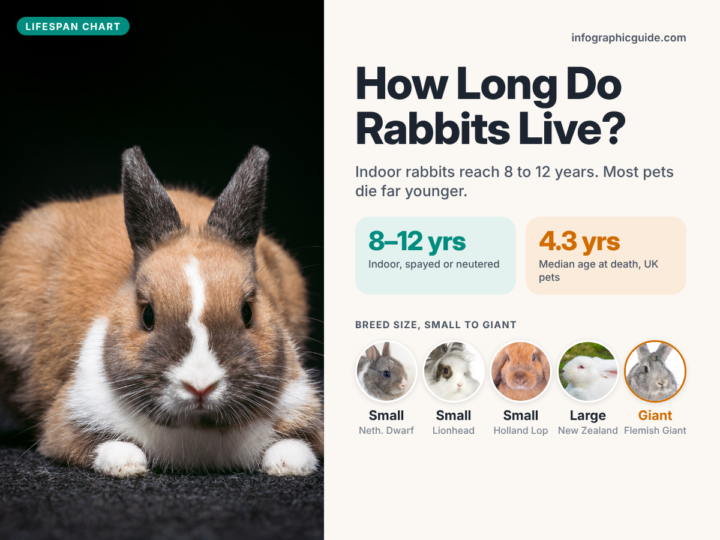
Explore the guide: How Long Do Rabbits Live? Lifespan Chart by Breed SizeExplore the small details, distinctive patterns, and interesting comparisons in this illustrated visual guide.
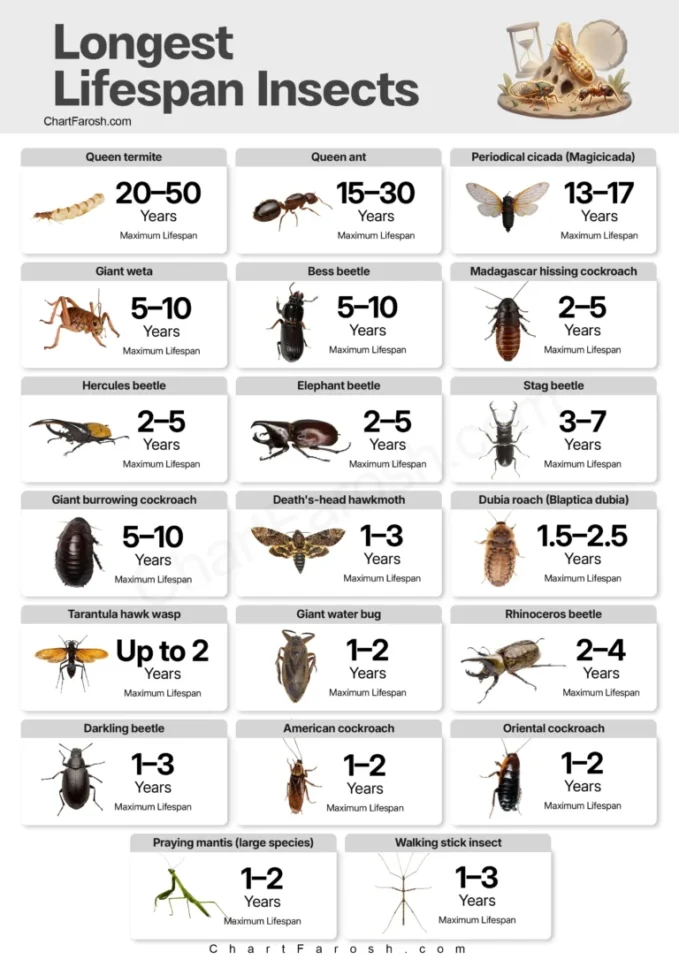
Explore the guide: Longest Insect Lifespans, Compared