Lifespan
How Long Do Dogs Live? Lifespan Chart by Breed Size
Explore the small details, distinctive patterns, and interesting comparisons in this illustrated visual guide.
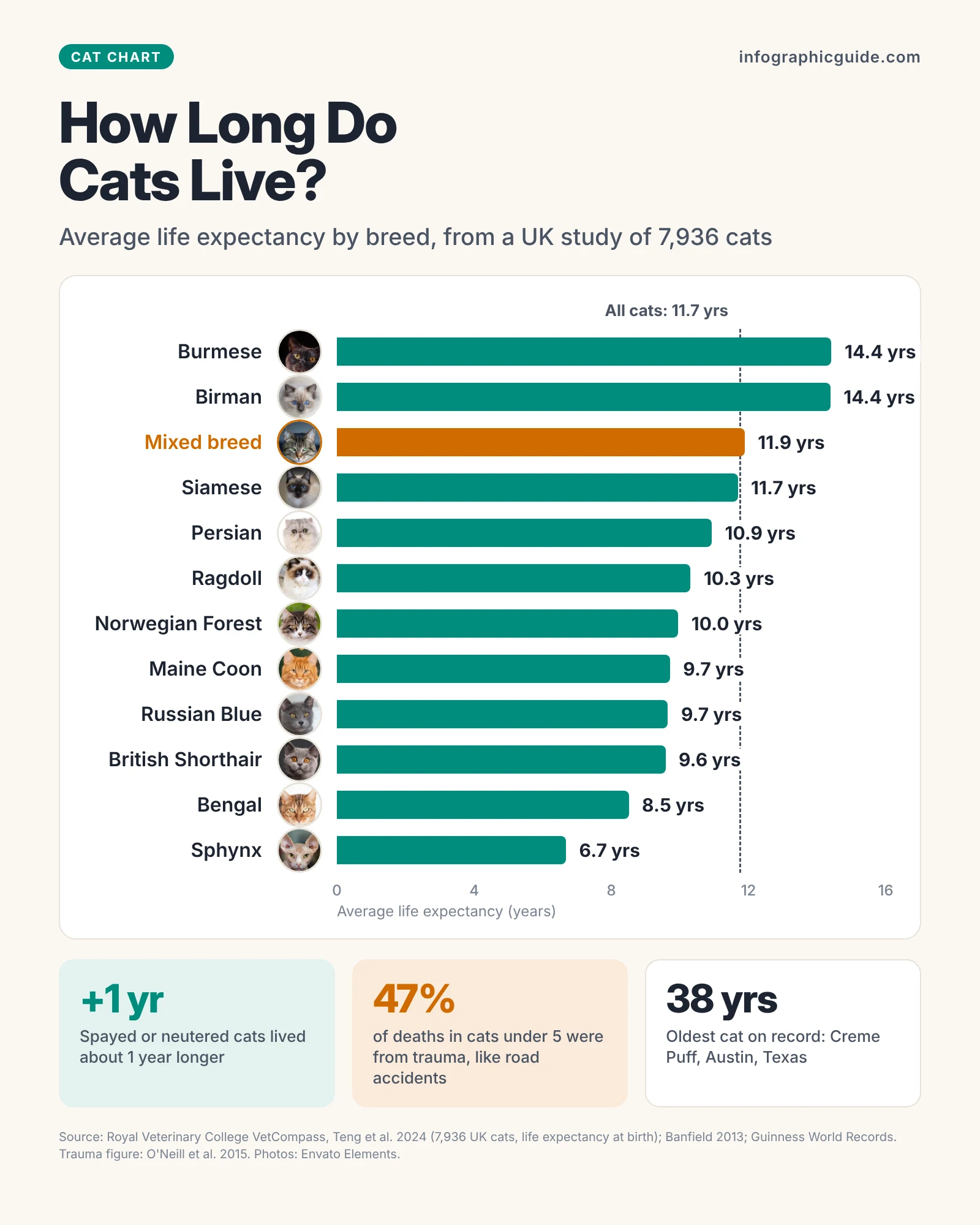
Explore the guide: How Long Do Dogs Live? Lifespan Chart by Breed SizeHow long do cats live? Most pet cats live 12 to 14 years. A 2024 study of 7,936 UK cats put average life expectancy at 11.7 years, and US vet chain Banfield reported a 12-year average. Many cats reach their late teens. Burmese and Birman cats live longest, at about 14.4 years.
| Group | Average life expectancy | Source |
|---|---|---|
| All pet cats (UK) | 11.7 years | RVC VetCompass, 2024 |
| All pet cats (US) | 12 years | Banfield, 2013 |
| Female cats | 12.5 years | RVC VetCompass, 2024 |
| Male cats | 11.2 years | RVC VetCompass, 2024 |
| Mixed-breed cats | 11.9 years | RVC VetCompass, 2024 |
| Purebred cats | 10.4 years | RVC VetCompass, 2024 |
| Burmese | 14.4 years | RVC VetCompass, 2024 |
| Birman | 14.4 years | RVC VetCompass, 2024 |
| Siamese | 11.7 years | RVC VetCompass, 2024 |
| Persian | 10.9 years | RVC VetCompass, 2024 |
| Ragdoll | 10.3 years | RVC VetCompass, 2024 |
| Norwegian Forest Cat | 10.0 years | RVC VetCompass, 2024 |
| Maine Coon | 9.7 years | RVC VetCompass, 2024 |
| Russian Blue | 9.7 years | RVC VetCompass, 2024 |
| British Shorthair | 9.6 years | RVC VetCompass, 2024 |
| Bengal | 8.5 years | RVC VetCompass, 2024 |
| Sphynx | 6.7 years | RVC VetCompass, 2024 |
| Oldest cat on record | 38 years | Guinness World Records |
“Life expectancy” is the average from birth. It counts kittens that die young, so it sits lower than the age most adult cats reach. An earlier UK study found the median cat died at 14, and half of all cats died between ages 9 and 17.
Breed makes a gap of nearly eight years between the longest- and shortest-lived cats in the 2024 UK data. Burmese and Birman cats averaged 14.4 years. Sphynx cats averaged 6.7 years, and Bengals 8.5. Large breeds such as the Maine Coon and Norwegian Forest Cat sat near 10 years. Our cat breeds chart covers how to tell these breeds apart.
Some breed numbers rest on small samples, so the ranges are wide. The Sphynx figure, for example, could be anywhere from 4.5 to 8.8 years. Treat breed averages as a guide, not a forecast for one cat.
Mixed-breed cats, the everyday “domestic shorthair,” averaged 11.9 years. Purebred cats averaged 10.4 years, about a year and a half less. For the everyday house cat with no pedigree, the mixed-breed number is the best single guide.
You will often see “indoor cats live 12 to 18 years, outdoor cats 2 to 5.” No large study has measured that, so we do not repeat it as fact.
What the data does show is that outdoor risks kill young cats. In a UK study of cats seen by vets, trauma caused 47% of deaths in cats under 5, and about half of those were road accidents. A second study found younger cats were more likely to die from trauma than older ones. Indoor-only cats avoid most of that risk. The AVMA says keeping cats in an enriched indoor space, an outdoor enclosure or on a leash lowers the danger. The Feline Veterinary Medical Association adds that indoor-only cats need play and enrichment to stay healthy.
Spaying and neutering is linked to longer lives in both large datasets. In the UK study, neutered cats that lived past 9 months lived about one year longer than intact cats. Intact cats had 4.3 times the odds of dying before age 3. In Banfield’s US records, neutered males lived 62% longer than intact males, and spayed females lived 39% longer than intact females.
Female cats outlived males by about 1.3 years in the 2024 study. Earlier UK research also linked heavier body weight with shorter lives. Cats count as seniors from age 10, according to the 2021 AAHA/AAFP Feline Life Stage Guidelines. Ask your vet how often your older cat should be checked.
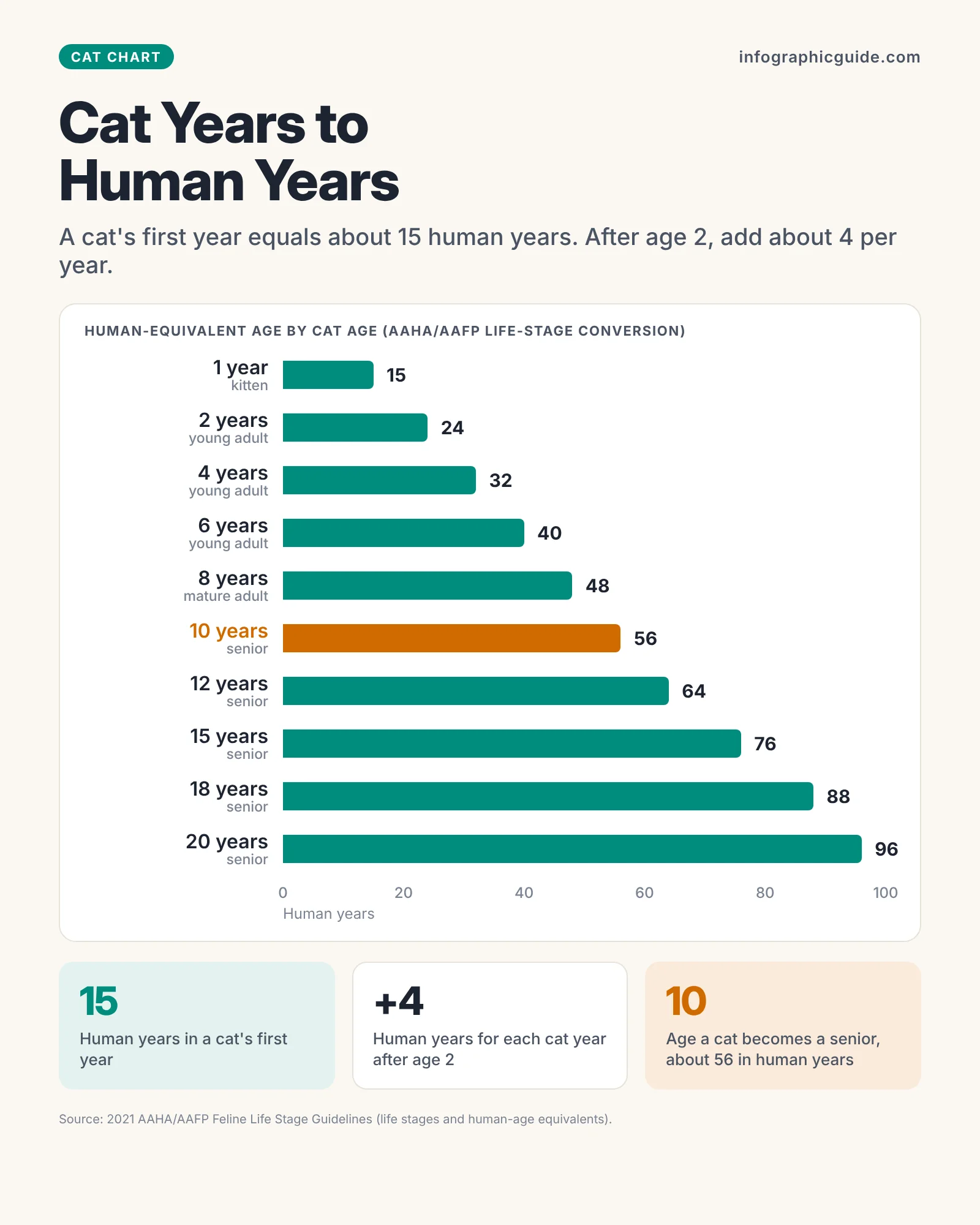
Cats age fastest in their first two years, then settle into a steady pace. The conversion used by the AAHA/AAFP Feline Life Stage Guidelines counts a cat’s first year as about 15 human years, the second as 9 more, and each year after that as about 4.
| Cat’s age | Life stage | Human equivalent |
|---|---|---|
| 6 months | Kitten | About 10 years |
| 1 year | Kitten | 15 years |
| 2 years | Young adult | 24 years |
| 4 years | Young adult | 32 years |
| 6 years | Young adult | 40 years |
| 8 years | Mature adult | 48 years |
| 10 years | Senior | 56 years |
| 12 years | Senior | 64 years |
| 15 years | Senior | 76 years |
| 18 years | Senior | 88 years |
| 20 years | Senior | 96 years |
On this scale, the average 12-year-old cat is in its mid-60s, and Creme Puff reached the equivalent of about 168.
None of these guarantee a long life, but each one is backed by the mortality data above.
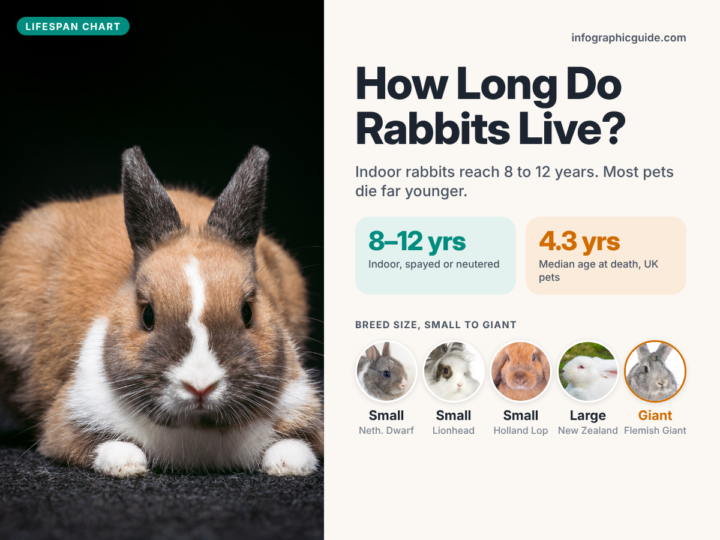
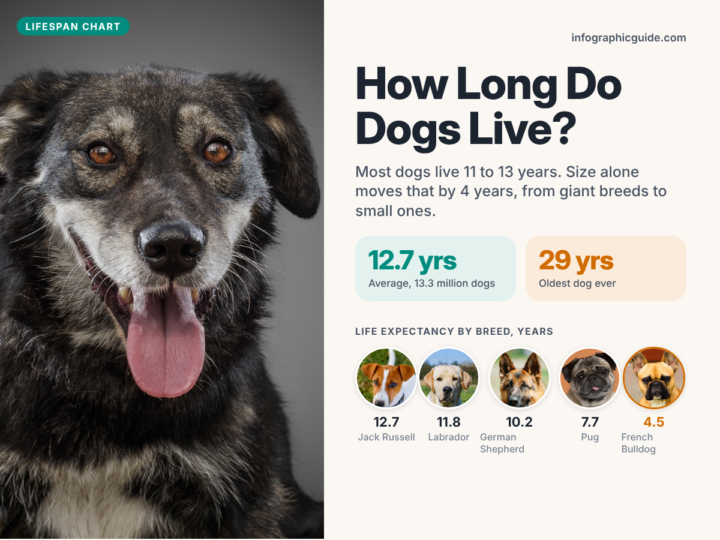
A typical cat outlives most small pets by a wide margin. Hamsters live about two to three years, and guinea pigs about four years on average, with a ceiling near eight. Rabbits and ferrets usually fall short of a cat as well. Dogs are the closest match, but dog lifespan depends heavily on size, so small dogs often outlive cats and giant breeds rarely do. The pets that clearly beat cats are large parrots, which can live for decades. See the full ranking in our pet lifespan chart, or how cats sit among 100 species in the animal lifespan chart.
The oldest cat on record is Creme Puff, a mixed-breed cat from Austin, Texas. Guinness World Records lists her lifespan as 38 years and 3 days, from August 3, 1967, to August 6, 2005. That is more than three times the average.
Records this old are hard to confirm. The AnAge longevity database lists 30 years as the maximum for domestic cats and notes that very high claims are difficult to verify. Even so, cats in their early 20s are not rare.
The average cat lifespan is about 12 years. A 2024 UK study of nearly 8,000 cats found an average life expectancy of 11.7 years, and Banfield’s US data showed 12 years. Many healthy cats live to 15 or older.
Indoor cats very likely live longer, but no large study gives exact figures. The clearest evidence is that trauma, including road accidents, caused 47% of deaths in UK cats under age 5. Keeping a cat indoors removes most of those risks.
In the 2024 UK study, Burmese and Birman cats lived longest, with an average of about 14.4 years each. Siamese cats came next among purebreds at 11.7 years. Mixed-breed cats averaged 11.9 years, longer than most purebreds.
A 1-year-old cat is about 15 in human years, a 2-year-old about 24, and each year after that adds about 4. So a 10-year-old cat is roughly 56, which is when the AAHA/AAFP guidelines class a cat as a senior.
Female cats live longer. In the 2024 UK study, females averaged 12.5 years and males 11.2 years, a gap of about 16 months. Spaying and neutering also raised lifespan for both sexes.
Explore the small details, distinctive patterns, and interesting comparisons in this illustrated visual guide.
Explore the guide: How Long Do Dogs Live? Lifespan Chart by Breed SizeExplore the small details, distinctive patterns, and interesting comparisons in this illustrated visual guide.
Explore the guide: How Long Do Rabbits Live? Lifespan Chart by Breed SizeExplore the small details, distinctive patterns, and interesting comparisons in this illustrated visual guide.
Explore the guide: Longest Insect Lifespans, Compared